
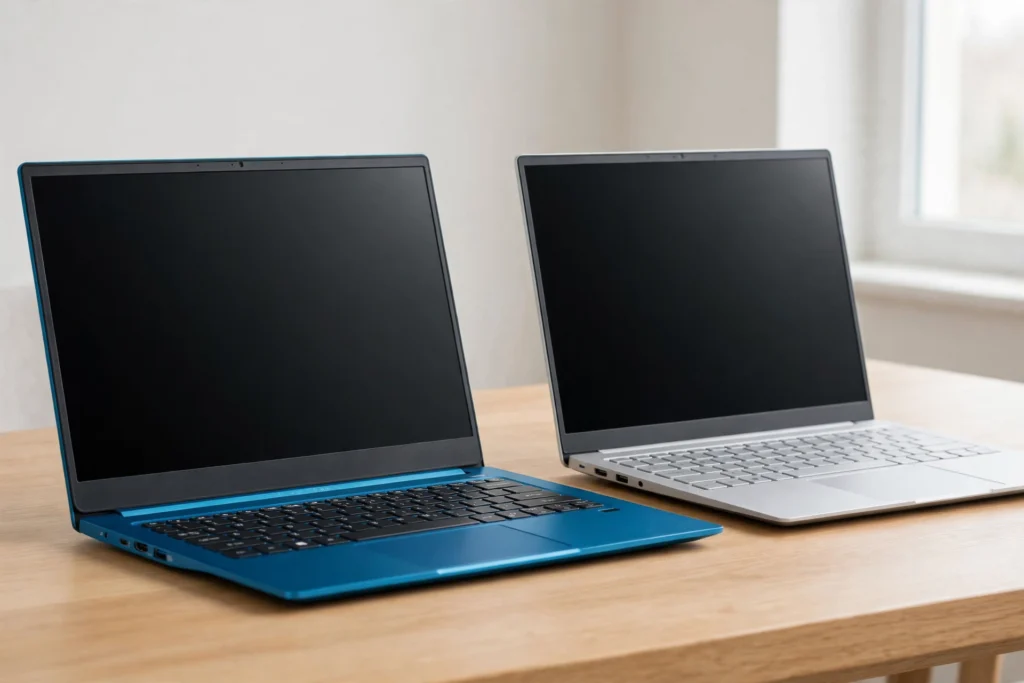
Acer vs Asus Googlebook: Which 14-Inch Googlebook Should You Buy?
The Acer Googlebook 14 and the Asus Googlebook 14 share the same base chip and the same 14-inch OLED screen size, but the Asus costs $400 more in the US. In Tom’s Guide’s same-test benchmarks (October 7, 2026), their speeds are nearly identical, so the extra money buys lighter weight, far better ports, and a matte screen, not speed.
Key takeaways
- The price gap is $400: the Acer starts at $899 and the Asus starts at $1,299.99 in the US, both checked November 23, 2026.
- Speed is a tie on the same test: Tom’s Guide measured Geekbench 6 at 2,465/9,960 for the Acer and 2,430/9,819 for the Asus (October 7, 2026).
- The Asus is lighter at 2.18 lb against 2.51 lb, and it has the best ports in the lineup: two Thunderbolt 4, two USB-A, full-size HDMI, and a headphone jack.
- The Acer is the only convertible Googlebook, and its glossy OLED measured brighter in HDR: 1,206 nits (Expert Reviews, October 2026).
- The Asus battery result is unresolved: Tom’s Guide’s own benchmark table lists 10 hours 19 minutes, while a secondary summary of its battery testing reported a 6 hour 18 minute first run.
- Watch the storage: the US Asus base model ships with 256GB, while the Acer base model ships with 512GB for $400 less.
How we wrote this. We have not tested either laptop. This early-reviews roundup uses published reviews with credit: Tom’s Guide, Notebookcheck, TechRadar, Expert Reviews, PCMag, Pocket-lint, BGR, XDA Developers, and Dave2D, plus Acer and Asus official specifications. Prices are US list prices, checked November 23, 2026.
Table of Contents
Acer vs Asus at a glance
The two Intel Googlebooks share a chip, a screen size, and an operating system, and differ on price, shape, weight, ports, and storage.
| Feature | Acer Googlebook 14 | Asus Googlebook 14 |
|---|---|---|
| US starting price | $899 (limited-time launch price) | $1,299.99 |
| Model number | GP714-91N | CX9406CAA |
| Processor | Intel Core Ultra 5 325 or Core Ultra 7 355 (Panther Lake), 8-core | Intel Core Ultra 5 325 or Core Ultra 7 355 (Panther Lake), 8-core |
| Display | 14-inch 2880×1800 OLED touch, 120Hz, glossy, 500 nits peak, 100% DCI-P3, DisplayHDR True Black | 14-inch 2880×1800 OLED touch, 120Hz, matte anti-glare, 450 nits typical, up to 1,000 nits HDR peak, 100% DCI-P3 |
| Memory and storage (US base) | 16GB LPDDR5X, 512GB PCIe Gen 4 SSD; up to 32GB and 512GB | 16GB LPDDR5X, 256GB PCIe Gen 4 SSD; up to 64GB and 1TB in higher configurations |
| Form factor | 360-degree convertible, hinge rated 20,000 cycles, USI 2.0 stylus-ready | Clamshell, MIL-STD 810H tested |
| Weight and thickness | 2.51 lb (1.14 kg), 13.9 mm thin | 2.18 lb (0.99 kg) claimed, 2.13 lb measured by Notebookcheck; 10.9 mm at its thinnest |
| Battery | 71Wh; Acer claims up to 16 hours web browsing | 70Wh; Asus claims up to 18 hours video playback |
| Ports | 2x USB-C 3.2 Gen 2, 1x Thunderbolt 4, headphone jack | 2x Thunderbolt 4, 2x USB-A 3.2 Gen 2, HDMI 2.1b, headphone jack |
Sources: Acer and Asus official specifications via Chrome Unboxed and Asus press material, September 2026; Google official comparison figures via our Googlebook specs guide; Notebookcheck measurements, October 15, 2026. Both launched October 4, 2026 in the US, after Google announced the lineup on September 21, 2026. See each model on its own in our Acer Googlebook 14 review and our Asus Googlebook 14 review.
Which is faster?
Neither is faster in any way that matters. Tom’s Guide tested both with the same base chip, the Intel Core Ultra 5 325, on October 7, 2026, and the scores are within 2 percent of each other.
| Test (Tom’s Guide, Oct 7, 2026) | Acer Googlebook 14 | Asus Googlebook 14 |
|---|---|---|
| Geekbench 6, single-core | 2,465 | 2,430 |
| Geekbench 6, multi-core | 9,960 | 9,819 |
| CrossMark, overall | 3,647 | 3,596 |
| 3DMark Wild Life Extreme | 4,068 points, about 24 fps | 4,608 points, 27.6 fps |
Source: Tom’s Guide, October 7, 2026. The Acer leads by about 1.4 percent on single-core, multi-core, and CrossMark, which is noise, not a win. The Asus leads by about 13 percent on the 3DMark graphics test, but neither reaches 30 fps, so neither is a gaming machine. Tom’s Guide summed it up plainly: the Acer, Asus, and Lenovo Googlebooks “generally scored similarly in the single- and multi-core tests.”
That result should surprise nobody: both use the same Intel Core Ultra 5 325 chip with 16GB of LPDDR5X RAM. The differences come from cooling and power limits, not silicon. Notebookcheck tested the faster Core Ultra 7 355 version of the Asus and measured Geekbench 7 at 2,518 single-core and 11,542 multi-core (October 15, 2026), but that is a different benchmark version, so do not compare it directly with the Geekbench 6 figures above.
Do not pay extra for the Core Ultra 7 on either model. Notebookcheck says the Asus Core Ultra 7 355 version costs about $300 more with the same RAM and storage, yet the chip is limited to around 18 watts sustained, so the extra speed rarely shows. PCMag adds a counterpoint from October 11, 2026: the Acer ranked first among the four Googlebooks it tested in WebXPRT 4 and PCMark Work 3.1 for Android. If raw speed is your priority, read our Acer vs Dell XPS Googlebook comparison instead, because the Dell Snapdragon chip is far faster than either Intel model.
Which screen is better?
It depends on where you work. The Asus screen is better in bright rooms, and the Acer screen is better for movies, photos, and color work in dim rooms.
On paper the panels are twins: both are 14-inch OLED touchscreens at 2880×1800 and 120Hz with 100 percent DCI-P3 color. The coating is where they split. The Asus uses matte anti-glare Gorilla Glass Victus, and the Acer uses a glossy panel that Acer’s own store listing labels CineCrystal (Glare). The Gadget Flow, writing on September 24, 2026, called the matte OLED the headline feature: “Glossy OLED in a dark bedroom is gorgeous. Put the same laptop on a train at noon, and I’d spend the ride staring at my own forehead.”
The brightness numbers need care, because the makers quote different kinds of figures. The Acer is rated at 500 nits peak, and Expert Reviews measured 520 nits in SDR and 1,206 nits in HDR (October 2026). The Asus is rated at 450 nits typical with up to 1,000 nits HDR peak, and Notebookcheck measured 525 nits in SDR and a 1,266 nit HDR peak (October 15, 2026). In raw brightness the two are close. The Gadget Flow warned against lazy math here: “Calling the ASUS twice as bright would be lazy math on my part. Its 1,000 nits is an HDR peak. Acer’s 500 is a plain rating.”
The real difference is calibration, and it favors the Acer. Notebookcheck found the Asus panel has a raised black level of 0.42 cd/m2, giving a measured contrast ratio of only 1,250:1, far below what an OLED panel should deliver. The panel is locked to the sRGB gamut with no calibration options, and color accuracy was poor, with a ColorChecker Delta E of 3.5 and a greyscale Delta E of 5.6. Notebookcheck explicitly advises against buying the Asus for photo or image editing. The Acer has no such problem reported: Expert Reviews called it “hugely likeable,” and TechRadar gave it 4 out of 5 in October 2026.
So choose by room, not by spec sheet. If you work by a window, on trains, or in bright offices, the Asus matte coating wins. If you watch movies, edit photos, or work in dim rooms, the Acer glossy OLED wins. The Acer also adds the convertible hinge, so the screen folds flat for reading and drawing, while the Asus lid opens only as far as a normal laptop lid. Compare the Acer against the bigger-screen option in our Acer vs Lenovo Googlebook 15 comparison.
Battery life: claims vs tests
Do not choose on battery life alone, and do not trust either maker’s headline claim. The claims are 16 hours for the Acer and 18 hours for the Asus, and no independent test has reached either figure in mixed work.
| Source and method | Acer Googlebook 14 (71Wh) | Asus Googlebook 14 (70Wh) |
|---|---|---|
| Maker claim | Up to 16 hours web browsing (Acer) | Up to 18 hours video playback (Asus) |
| Tom’s Guide live-web test, 150 nits, 120Hz (Oct 2026) | 10 hours 25 minutes | 10 hours 19 minutes in the benchmark table |
| Notebookcheck Wi-Fi browsing, 150 nits (Oct 15, 2026) | Not tested | 13 hours 20 minutes; 8 hours 5 minutes at full brightness |
| Expert Reviews local video playback (Oct 2026) | Not tested | 12 hours 30 minutes |
| The Verge, light to moderate use (Oct 2026) | 8 to 9 hours | Not tested |
Sources: Tom’s Guide, October 7 and 9, 2026; Notebookcheck, October 15, 2026; Expert Reviews and The Verge, October 2026. The two batteries are nearly the same size, 71Wh against 70Wh, so the similar results make sense.
One conflict needs to be stated honestly. Tom’s Guide’s own benchmark table lists the Asus at 10 hours 19 minutes, but a secondary summary of Tom’s Guide battery testing reported a 6 hour 18 minute first run for the Asus, with a 6 hour 50 minute average across two runs. Tom’s Guide has been contacted about that result, and the laptop may have had a defect. Until that is resolved, treat the Asus battery as the least certain number in this comparison: the gentle tests say 12 to 13 hours, the heavy live-web test says about 10 hours, and one report says far less. The Acer is the safer battery pick, because its 10 hour 25 minute result is consistent across reports, while the Asus result is not. If battery is your top priority, the Snapdragon models do better: see our Dell vs HP Googlebook comparison.
Design, weight, and everyday use
The Asus is the travel laptop. The Acer is the versatile laptop. Your daily habits decide which matters more.
The Asus weighs 2.18 lb (0.99 kg) claimed, and Notebookcheck measured 967 g on its scale, which is 2.13 lb, at 10.9 mm at its thinnest point (October 15, 2026). The Acer weighs 2.51 lb (1.14 kg) and is 13.9 mm thin. That is a 0.33 lb gap, about the weight of a small paperback, and you will feel it at the end of a long day. BGR noted on October 10, 2026 that the Asus finish can feel a little plasticky, with some flex in the keyboard bed and lid.
The Acer is the only Googlebook that folds. Its 360-degree hinge, rated for 20,000 open-and-close cycles, gives laptop, tent, stand, and tablet modes, and the screen is USI 2.0 stylus-ready, though the pen is sold separately. The catch, spotted by The Verge in October 2026, is that Googlebook OS does not yet support portrait orientation, so auto-rotate only flips the screen 180 degrees. At 2.51 lb it is also a heavy tablet. The Asus is a clamshell only, with no folding and no stylus story.
Typing and sound favor the Asus. It has a backlit keyboard with 1.5 mm of travel and a 6-inch haptic touchpad with six-point force sensing, which Windows Central called “immediately fantastic” in October 2026. PCMag called the Acer keyboard “squishy” while praising its smooth oversized touchpad (October 11, 2026). The Asus has a six-speaker system with dual force-canceling woofers that Notebookcheck rated the best audio in its comparison class, against the Acer’s two upward-facing DTS units. Both have a fingerprint reader in the power button, a webcam with a physical privacy shutter, Wi-Fi 7, Bluetooth 6.0, and Google’s Titan security chip. The Acer webcam is 5MP; the Asus webcam is 1080p. Neither laptop offers 5G or LTE, and the RAM is soldered on both, so buy the memory you need on day one.
Ports: the Asus wins by a wide margin
If you plug things in, this section may settle the whole comparison. The Asus has the best port selection in the Googlebook lineup, and the Acer has the weakest.
| Port | Acer Googlebook 14 | Asus Googlebook 14 |
|---|---|---|
| Thunderbolt 4 (USB-C) | 1 | 2 |
| USB-C 3.2 Gen 2 | 2 | 0 (the Thunderbolt ports cover USB-C) |
| USB-A 3.2 Gen 2 | 0 | 2 |
| Full-size HDMI | 0 | 1 (HDMI 2.1b) |
| Headphone jack | Yes | Yes |
Sources: Acer and Asus official specifications, September 2026; Notebookcheck, October 15, 2026. The Asus HDMI 2.1b port means a hotel TV or a meeting-room projector needs nothing but the cable already in your bag, and the two USB-A ports take a wireless mouse receiver or an old card reader with no adapter. The Gadget Flow called the Asus “the anti-dongle laptop” and said it wins on ports “by a wide margin.” The Acer went all USB-C, which is enough if you already live on USB-C, but there is no USB-A and no HDMI, so budget for a hub if you use older accessories.
Now the storage warning, because it is easy to miss and expensive to fix. The US Asus base model ships with a 256GB SSD, while the US Acer base model ships with a 512GB SSD. You pay $400 more for the Asus and get half the storage in the base configuration. Higher Asus configurations go up to 64GB of RAM and 1TB of storage, against up to 32GB and 512GB on the Acer, but those cost more again. Compare every model’s price and storage in our Googlebook price guide.
Price and value: is the Asus worth $400 more?
For most buyers, no. The $400 buys lightness, ports, speakers, and a matte screen. It does not buy speed, battery life, storage, or a better screen for color work.
| Region | Acer Googlebook 14 | Asus Googlebook 14 |
|---|---|---|
| United States | $899 | $1,299.99 |
| United Kingdom | £999 | £1,199.99 |
| Canada | Not confirmed in our sources | $1,799 CAD |
| Europe | €1,199 | €1,699 (Notebookcheck review unit) |
Sources: Acer launch pricing via Chrome Unboxed, September 2026; Asus press release and store pages, September and October 2026; PCMag confirmed $899.99 at Best Buy for the Acer GP714-91N-50A0. Both include the same launch bundle: 12 months of Google AI Pro, three months of YouTube Premium, and one year of GeForce NOW (Google, September 21, 2026).
Two warnings before you buy. First, Acer says the $899 price is a limited-time launch price that may be reassessed, per The Verge, so it is not guaranteed to last. Second, the Asus price has already drawn “wait for a price drop” advice: iPhone in Canada advised waiting on October 13, 2026, and noted that $1,799 CAD buys a 13-inch M5 MacBook Air with the same RAM and storage. Dave2D made the same point in a video summarized in November 2026: at $1,300 he expects a full computer. If the platform itself is the question, read our Googlebook vs MacBook Air comparison before you spend $1,300.
What the reviewers say
Reviewers agree on the hardware and disagree only on whether it is worth the money yet. Both laptops are well built and well reviewed, and both run the same unfinished software.
| Reviewer | Date | Acer Googlebook 14 | Asus Googlebook 14 |
|---|---|---|---|
| TechRadar | October 2026 | 4 out of 5; “very good first attempt at a new breed of device” | Not reviewed |
| Expert Reviews | October 2026 | “Hugely likeable laptop held back by the usual early-adopter snags”; measured 520 nits SDR, 1,206 nits HDR | “Lovely hardware; now, about that software”; called the battery mediocre |
| PCMag | October 11, 2026 | First among four Googlebooks tested in WebXPRT 4 and PCMark Work 3.1 | Not in that comparison |
| Notebookcheck | October 15, 2026 | Not reviewed | 86.5%; “a very lightweight companion for everyday tasks within the Android ecosystem, but Googlebook OS is limited” |
| Pocket-lint | October 5, 2026 | Not reviewed | 80%; “sprinkled with hints of greatness” |
| BGR | October 10, 2026 | Not reviewed | “A lot to like: a stunning display, pretty good performance, reasonably sturdy”; warned many apps will not run as well on Intel as on Snapdragon Googlebooks |
| Dave2D (video) | November 2026 | Not covered | Hardware excellent, software not ready for what the laptop costs |
| The Verge | October 22, 2026 | 4 out of 10; praised the chassis and OLED, said the software overshadows the strengths | Covered in the same five-model review; same software verdict |
The shared warning matters more than any single score. The Verge reviewed all five Googlebooks on October 22, 2026, said Googlebook OS feels like a beta, and does not recommend buying any Googlebook in its current state. Google shipped fixes for external monitors, Bluetooth audio, and Linux Terminal on November 5, 2026, but the platform is still young. App compatibility hits these two Intel models hardest: BGR warned that most Android apps were built for ARM phones, so plenty will not run as well on Intel Googlebooks as on the Snapdragon models, and Windows Central found Slack, Microsoft Edge, and DaVinci Resolve all had problems on the Asus in October 2026.
Verdict: choose Acer if, choose Asus if
There is no single winner. The choice turns on one question: do you want the cheapest way into Googlebook with a folding screen, or the lightest bag with the best ports?
Choose the Acer Googlebook 14 if you want the lowest price at $899, the only convertible hinge in the lineup, a stylus-ready screen for notes or drawing, a brighter HDR OLED for movies and photo work, double the base storage at 512GB, and the more consistent tested battery. Read our full Acer Googlebook 14 review before you buy.
Choose the Asus Googlebook 14 if you carry your laptop all day at 2.18 lb, work in bright rooms where the matte OLED matters, present on projectors and plug in older accessories without a dongle, want the best speakers and the best keyboard and trackpad in this pair, and accept 256GB in the base model. Read our full Asus Googlebook 14 review before you buy.
Wait if the software warning matters more than the hardware. If your current laptop still works, waiting gives you a more finished Googlebook OS, a resolved Asus battery answer, and possibly a lower Asus price. The Gadget Flow picked the Asus for 90 percent of buyers on September 24, 2026, but that was written before launch with no test data; on the tested evidence, the Acer is the better value for most buyers. If you are choosing between the Intel pair and the Snapdragon pair, read our Dell vs HP Googlebook comparison next.
FAQ
Is the Asus Googlebook 14 worth $400 more than the Acer Googlebook 14?
For most buyers, no. The Asus costs $1,299.99 against $899 for the Acer, and Tom’s Guide found their speeds nearly identical on the same test (October 7, 2026). The $400 buys a lighter body, better ports, better speakers, and a matte screen, but the Asus base model has only 256GB of storage against 512GB on the Acer.
Which is faster, the Acer or the Asus Googlebook?
Neither, in any meaningful way. Tom’s Guide measured Geekbench 6 at 2,465/9,960 for the Acer and 2,430/9,819 for the Asus (October 7, 2026), a gap under 2 percent. The Asus leads by about 13 percent on 3DMark graphics, but neither reaches 30 fps. Both use the same Intel Core Ultra 5 325 chip.
Which has the better screen, the Acer or the Asus Googlebook?
It depends on the room. The Asus matte OLED is better in bright rooms because it cuts reflections. The Acer glossy OLED is better in dim rooms and for photo work: Expert Reviews measured 1,206 nits HDR on the Acer, while Notebookcheck found the Asus panel has poor color calibration and only 1,250:1 contrast.
Which Googlebook has better battery life, the Acer or the Asus?
The Acer. Tom’s Guide measured 10 hours 25 minutes for the Acer and 10 hours 19 minutes for the Asus (October 2026). The Asus result is unresolved: a secondary summary reported a 6 hour 18 minute first run, while Notebookcheck measured 13 hours 20 minutes in a gentler test. Neither reaches its claimed 16 or 18 hours.
Should I buy a Googlebook now or wait?
Wait if your current laptop still works. The Verge reviewed all five Googlebooks on October 22, 2026, said Googlebook OS feels like a beta, and does not recommend buying any Googlebook yet. Google shipped fixes on November 5, 2026, but the platform is still young. Buy now only if you need a laptop today and you mostly use web apps.
Conclusion
The Acer and the Asus are the same laptop in two different shapes: same chip, same screen size, same unfinished software. The Acer is the better value for most buyers at $899, with the convertible hinge, the brighter HDR screen, and double the base storage. The Asus is the better laptop for a specific buyer: someone who carries it all day, works in bright rooms, and plugs into projectors and old accessories without a dongle. Pay $1,299.99 for that buyer, and $899 for everyone else. Compare prices in our Googlebook price guide first.
Related guides: Googlebook vs MacBook Air: Which Should You Buy? | Acer Googlebook 14 review | Asus Googlebook 14 review | Googlebook price guide | Acer vs Dell XPS Googlebook | Googlebook specs: all 5 models compared
Sources:
- Tom’s Guide benchmarks, October 7, 2026: https://www.tomsguide.com/computing/laptops/we-just-benchmarked-the-first-5-googlebooks-and-intel-should-be-worried
- Tom’s Guide battery test, October 9, 2026: https://www.tomsguide.com/computing/laptops/googlebooks-have-a-battery-life-problem-heres-what-our-results-show
- Notebookcheck, Asus Googlebook 14 review, October 15, 2026: https://www.notebookcheck.net/Asus-Googlebook-14-Laptop-Review-An-ExpertBook-Ultra-with-a-Glowbar.1423934.0.html
- TechRadar, Acer Googlebook 14 review, October 2026: https://www.techradar.com/computing/laptops/acer-googlebook-14-review
- Expert Reviews, Acer Googlebook 14 review, October 2026: https://windowsforum.com/news/acer-googlebook-14-review-premium-android-laptop-with-app-gaps-and-no-it-management-yet.448130/
- Expert Reviews, Asus Googlebook 14 review, October 2026: https://www.expertreviews.co.uk/technology/laptops/asus-googlebook-14-review
- PCMag, Acer Googlebook 14 review, October 11, 2026 (via Neoteo): https://www.neoteo.com/en/acer-googlebook-14-review-benchmarks-and-limits
- Pocket-lint, Asus Googlebook 14 review, October 5, 2026 (score and verdict cited via our Asus Googlebook 14 review; direct article URL not verified, so none is given here)
- BGR, Asus Googlebook 14 review, October 10, 2026 (via Ghanamma): https://www.ghanamma.com/2026/10/10/asus-googlebook-14-review-for-android-by-android/
- The Gadget Flow, Acer vs Asus Googlebook 14, September 24, 2026: https://thegadgetflow.com/blog/acer-googlebook-14-vs-asus-googlebook-14/
- InnoReviews, Acer vs Asus Googlebook 14 spec comparison, checked November 23, 2026: https://innoreviews.com/compare/laptops/acer-googlebook-14-vs-asus-googlebook-14
- Techlicious, Which Googlebook is right for you, September 29, 2026: https://www.techlicious.com/guide/which-googlebook-should-you-buy/
- Dave2D Asus Googlebook 14 verdict, November 2026 (via FluenceDesk summary): https://fluencedesk.com/googlebook-review-who-the-asus-googlebook-14-is-for-and-who-should/
- Chrome Unboxed, Acer Googlebook 14 official, September 21, 2026: https://chromeunboxed.com/the-acer-googlebook-14-is-official-the-only-360-convertible-in-the-lineup-starts-at-899/
- Chrome Unboxed, Asus Googlebook 14 official, September 21, 2026: https://chromeunboxed.com/the-asus-googlebook-14-is-official-2-18-pounds-3k-oled-and-panther-lake-power/
- Asus press release, September 23, 2026: https://press.asus.com/news/press-releases/asus-googlebook-14-gemini-intelligence/
- Google, Googlebook launch post, September 21, 2026: https://blog.google/products-and-platforms/devices/googlebook/pre-order-googlebook/
By Joshe Martin. Joshe Martin covers Googlebook and Chromebook laptops for ailaptopguide.com, focusing on prices, specs, and practical buying advice. We have not tested either laptop. This is an early-reviews roundup based on published reviews and official sources, with every figure credited to a named source and date.
